LeetCode vs FinishDSA: Which One Actually Gets You Placement-Ready?


LeetCode vs FinishDSA: Which One Actually Gets You Placement-Ready?
By FinishDSA
Let me start with something honest.
This is a comparison written by FinishDSA. So take the framing with appropriate skepticism. What I'll try to do is describe both platforms as accurately as possible, including where LeetCode is genuinely better, and let you decide what you actually need.
Because here's the thing: LeetCode is a great platform. It has 3,000+ problems. It has a massive community. It has been the primary tool for interview preparation for over a decade. If you're preparing for Google, Meta, or Amazon, LeetCode is probably the first place you should go.
But for a specific student, a tier 2 or tier 3 college student who is 3-6 months from campus placement season, who doesn't have a structured curriculum, who is learning largely on their own, and who keeps starting DSA but never actually finishing it, LeetCode may be actively working against you.
Here's why.
What LeetCode is actually designed for
LeetCode was built for engineers who already know DSA and need to practice for interviews at top companies.
Read that sentence again.
It assumes you know the patterns. It assumes you understand which data structures exist and when to reach for them. It assumes you can look at a Hard problem and contextualize it within your existing knowledge.
The 3,000 problems are not a curriculum. They're a practice ground. And a practice ground is only useful if you already have the skills that need practicing.
LeetCode is a gym. A gym is fantastic if you already know how to train. If you walk into a gym with no program, no coach, and no idea what you're trying to build, you'll wander between machines, do random things for an hour, and leave feeling tired but not actually stronger.
That's what most tier 2/3 students experience on LeetCode. Not because they're not smart. Because they're using a practice ground when what they need is a starting path.
The specific problems LeetCode creates for beginners
Problem 1: No guidance on where to start
3,000 problems. Sorted by difficulty. Also sorted by category. Also sorted by company. Also sorted by acceptance rate.
So many ways to slice the problem set. No clarity on what a beginner should actually do first.
Students usually default to two approaches: start from Easy and work up, or copy a "must-do list" from Reddit. Both have problems.
Starting from Easy gives you false confidence. Many Easies are either trivially simple or extremely niche edge cases. They don't teach the core patterns. Working through 100 Easies without touching the foundational Medium problems is the fastest way to build a high problem count with low actual skill.
Reddit lists give you a set of problems but no framework for why those problems matter. You're back to the original problem: what is this problem trying to teach me?
Problem 2: No feedback on your thinking
LeetCode tells you if your solution passes the test cases. It does not tell you if your approach is right. It does not tell you if there's a cleaner pattern you should be learning. It does not tell you if you solved the problem in the hardest possible way when a much simpler approach exists.
This is fine if you already know the patterns and can evaluate your own solution. It's a problem if you're just learning.
You can submit a solution that passes all test cases and still learn the wrong lesson from that problem. LeetCode won't tell you. You won't know.
Problem 3: No progression logic
LeetCode doesn't know whether you actually understood the problem or got lucky with a brute force that happened to pass within the time limit. There is no adaptive component. The platform doesn't respond to your performance and suggest what you should do next.
For a self-directed learner with a clear plan, this is fine. For a beginner trying to figure out what to do next, it means you're constantly making decisions with no information.
What FinishDSA is actually designed for
FinishDSA was built specifically for the student who is starting DSA from scratch or has been stuck in the "grinding without finishing" loop.
The platform is built on three principles.
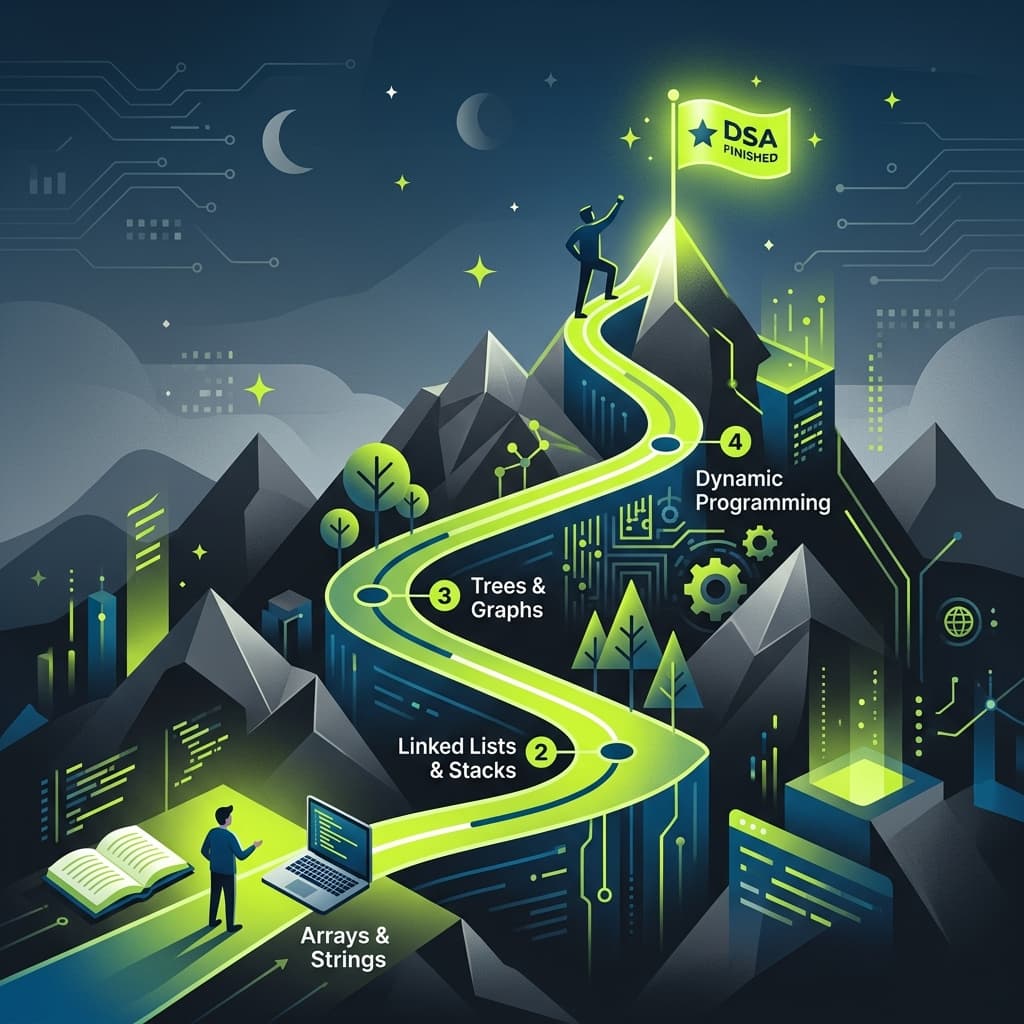
Structure first. 250 problems, 10 patterns, organized as islands. You don't decide what to do next. The roadmap does. Each island is a pattern. Each pattern is a complete unit of learning with a clear beginning, middle, and end.
Understanding over count. Every problem you submit gets analyzed not just for correctness but for approach. The AI feedback tells you why your solution works the way it does, where you might be missing a cleaner insight, and what the underlying pattern looks like across different problems.
Adaptive progression. The roadmap adjusts based on how you're actually doing, not how many problems you've submitted. If you're breezing through sliding window problems, it moves you forward faster. If you're struggling with tree recursion, it keeps you on trees longer and surfaces problems that address your specific gap.
The honest comparison
Problem variety
LeetCode wins. 3,000+ problems vs 250. If you're looking for sheer volume of practice material, there is no competition. LeetCode has problems for every possible niche scenario you might encounter, including interview problems from specific companies.
Structure for beginners
FinishDSA wins. If you're starting from zero, the 10-island structure gives you a clear path. You know where you are. You know what comes next. You know when you've finished a pattern.
LeetCode's "explore" section attempts this, but it's not adaptive and the curated learning paths are much thinner than the free-form problem set.
Feedback quality
FinishDSA wins for conceptual feedback. LeetCode wins for technical feedback.
LeetCode's runtime analysis, memory analysis, and comparison to other solutions is excellent. You can see exactly how efficient your solution is.
FinishDSA's AI feedback on why your approach does or doesn't match the optimal pattern for that problem type is something LeetCode doesn't offer.
Community
LeetCode wins. The discussion section on LeetCode for any well-known problem is an incredible resource. You can see dozens of approaches, read explanations in multiple languages, and find the solution style that clicks for you. The FinishDSA community is much smaller.
Placement-specific preparation
FinishDSA wins for Indian placement context.
LeetCode is optimized for FAANG-level interviews. The Hard problems on LeetCode are calibrated for Google and Meta SDE-2 and above.
Indian campus placement tests, especially for tier 2 and tier 3 students targeting service companies, mid-tier product companies, and startups, require strong fundamentals in the core patterns but not necessarily the extreme edge cases that LeetCode Hards specialize in.
FinishDSA's 250-problem set is calibrated for this specific context. Getting genuinely fluent with these 250 problems in the right order will prepare you for 80-90% of what you'll face in a campus placement round.
Cost
Both have free tiers. LeetCode Premium is roughly $35/month. FinishDSA's paid tier is priced for tier 2/3 students specifically, significantly less.
Who should use which platform
Use LeetCode if:
You already have solid fundamentals and you're polishing for top company interviews. You need exposure to very hard problems and rare edge cases. You want the largest possible problem set. You benefit from a massive community discussion section.
Use FinishDSA if:
You're starting DSA with less than 6 months to placement. You've been grinding without a clear structure and feel like it's not working. You want feedback on your thinking, not just whether your code passes. You're a tier 2/3 student preparing for Indian campus placements specifically.
Use both if:
You have more than 6 months. Start with FinishDSA to build genuine pattern fluency on the 250 core problems. Then move to LeetCode for volume practice once you have the foundation. This is actually the optimal sequence for most students.
The real question
LeetCode vs FinishDSA is not actually the most important question.
The most important question is: what do you need right now?
If you need a map, you need a map. The largest collection of terrain in the world isn't helpful if you don't know where you are or which direction to walk.
If you need practice volume after you have the map, LeetCode is unbeaten.
Most tier 2/3 students at the start of their placement prep need the map. They need someone to show them the 10 patterns, give them the 250 right problems in the right order, and adjust the path based on how they're actually doing.
After that, they can go anywhere.
But you have to know the patterns before you can practice them. And a platform with 3,000 problems and no guidance on where to begin is not going to teach you the patterns. It's going to give you the illusion of progress while the gap between problem count and actual skill keeps growing.
That gap is what placement rounds expose.
Build the foundation first. Then build the volume.
Stop grinding. Start finishing.
FinishDSA: 250 problems. 10 patterns. An AI that adjusts your roadmap based on what you actually understand, not just what you've submitted. Built by a tier 2 student, for tier 2 students.